The Kyjov Moravian Ensemble is active in the historical town of Kyjov – one of the centers of ethnographic events in southeastern Moravia.

Since 1942, it has been dedicated to discovering, preserving and developing the folklore traditions of the Kyjov region and passing them on to future generations.

Learn the story of the Kyjov Moravian Ensemble

Download an electronic brochure mapping the history of the ensemble from 1942 to the present day. Available in Czech language only.

1942
Establishment
Establishment of the ensemble in Kyjov

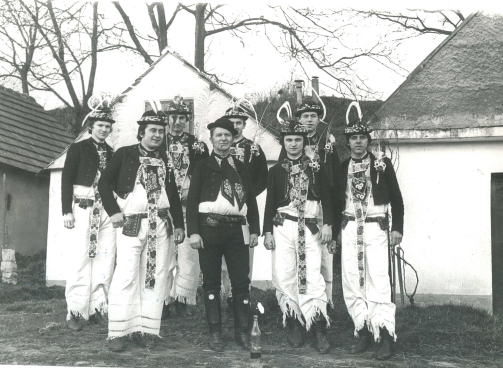
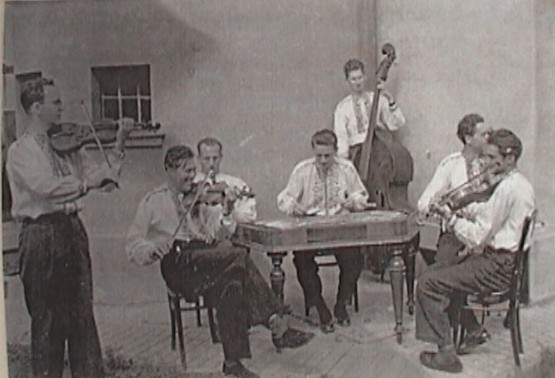
The real beginning can be considered the year 1940, when, after the closure of universities by the Nazi occupants, students returned to Kyjov and, with the support of Dr. Vladimír Úlehla, a circle of people spontaneously gathered around the Academic Club for songs and dances; the meetings took place in private in the back rooms of the Slávia Hotel, in nearby villages and in wine cellars.

In 1941, the musicians play together (Oldřich "Ondráš" Stokláska is prominent), the repertoire is enriched by friends from Uherské Hradiště (Jaroslav Lakosil), there are few costumes, people often play "only" in shirts - but enthusiasm is decisive.

February 14, 1942 is the first dated entry in the chronicle and the year 1942 is taken as the founding of the "Slovácký krúžek". The founding members were mainly František Lukl, Oldřich Stokláska, Josef Sedlář and others).
1945
Union of Czech Youth

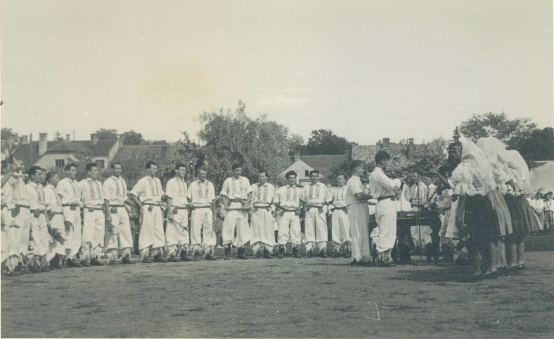
In Nětčice (part of Kyjov), the Union of Czech Youth was founded, under whose banner the activities of the ensemble continued. After the war, when most of the members returned to school, the remaining part joined the Nětčice youth, which was reflected in the song repertoire, mainly thanks to Kliment Navrátil.

The chairman was Josef Sedlář.
1949
Independence

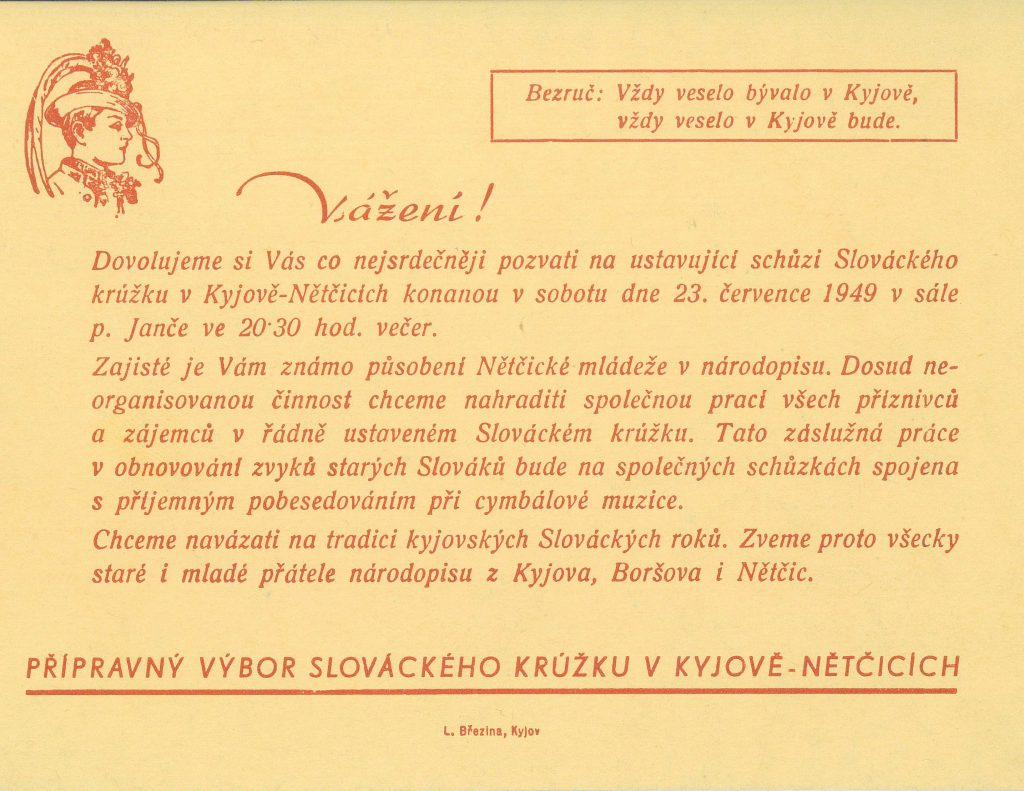
The members submit an application for the establishment of an independent ensemble. The ensemble is authorized and established. L. Fiala, a teacher at the Kyjov grammar school, becomes the chairman.
1952
Moravia Glass Factory Club

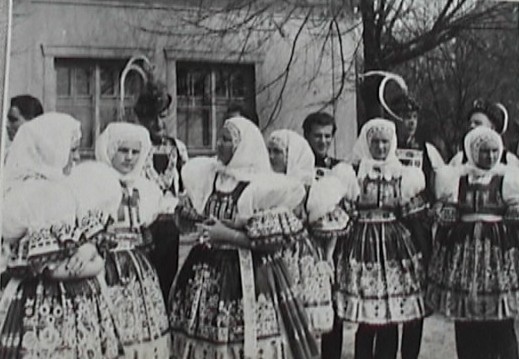
The ensemble becomes part of the Moravia Glass Factory Club. The chairman is Josef Fridrich (in office until 1961).
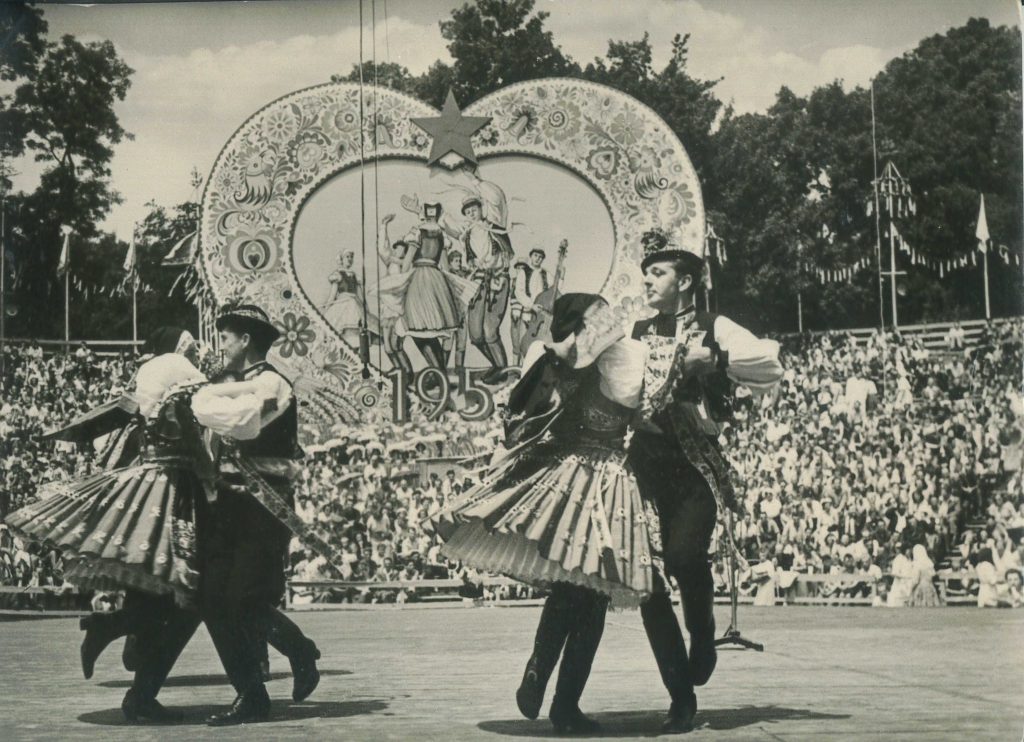
The 50s
First public performances

In addition to the traditional folk events in Kyjov, public performances are also starting to take place in other cities.
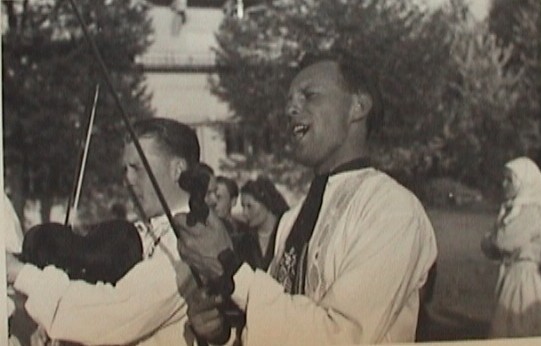
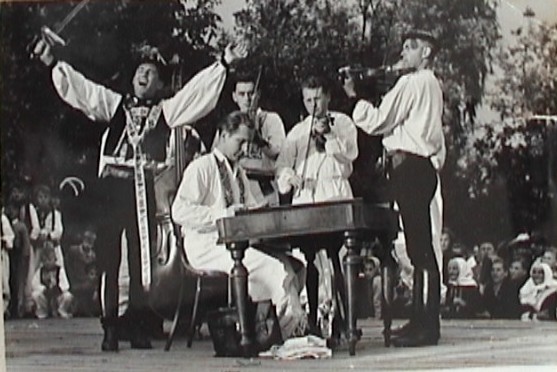
since 1958
The ensemble performs with the cimbalom band of Jura Petrů
1958–1980
Additional cimbalom bands
The ensemble cooperates with various cimbalom bands, including those led by Augustýn Kúr, Hynek Bím, Karel Hirsch and Jura Petrů, as well as musicians from Svatobořice centred around Josef Varmuža Sr. The ensemble also regularly collaborates with the cimbalom band led by Jan Slaměna.
until 1969

The 1960s were one of the quietest periods in the history of the ensemble. While in 1961 the Men's Choir was established under the leadership of Jiří and Josef Wenzl, the dance ensemble saw rapid changes in cimbalom bands and leaders, and so the dance ensemble was in decline for most of the decade. The generation that carried the post-war boom gradually left and the new one had not yet been fully established. Some events are organized literally ad hoc.

1970/1971 – Return to the rhythm
Zdeněk Šimeček follows up on the work of Bohumil Frýbort and introduces regular rehearsals, effectively restarting the activity after the decline; at the same time, a new chronicle is established and the ensemble gains a permanent band led by Ing. Karel Hirsch. The energy from the rehearsals quickly translates onto the stage – already in 1971 the ensemble performances at the Slovak-Moravian Year are highly praised. At the same time, in 1972 the Women's Choir was established with Josef Wenzl as its leader.
1973 – The Cultural Centre changes the game

The ceremonial opening of the Cultural Centre provides a professional background for rehearsals and premieres and unites most events "under one roof". At the same time, Bedřich Gazda starts the prep-group for teenage dancers, so the ensemble gains a stable "incubator" of new dancers and strengthens its long-term sustainability.
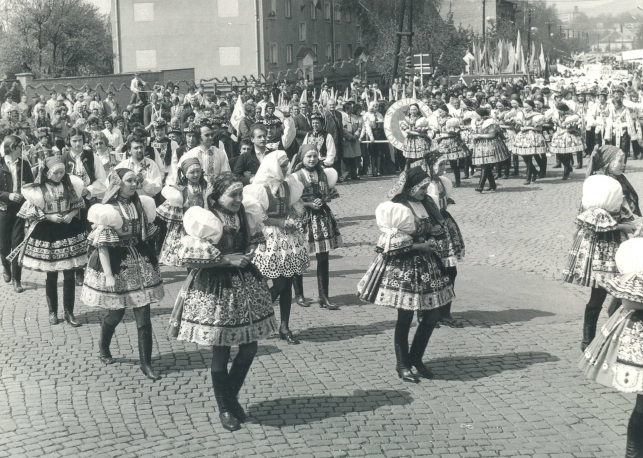
The 1970s
Stabilization

Especially in the second half of the 1970s the group switches to ensemble (stage) activities. It develops dramaturgically guided programs and at the same time maintains traditional customs (carnival, erecting and felling of the Maypole, harvest festival, Hody-time feast). The number of performances outside Kyjov increases significantly and cooperation with Czechoslovak Television Brno is also established. The highlight for the members was the trip to Belgium in 1978 (Kortrijk, Ieper, Brussels).
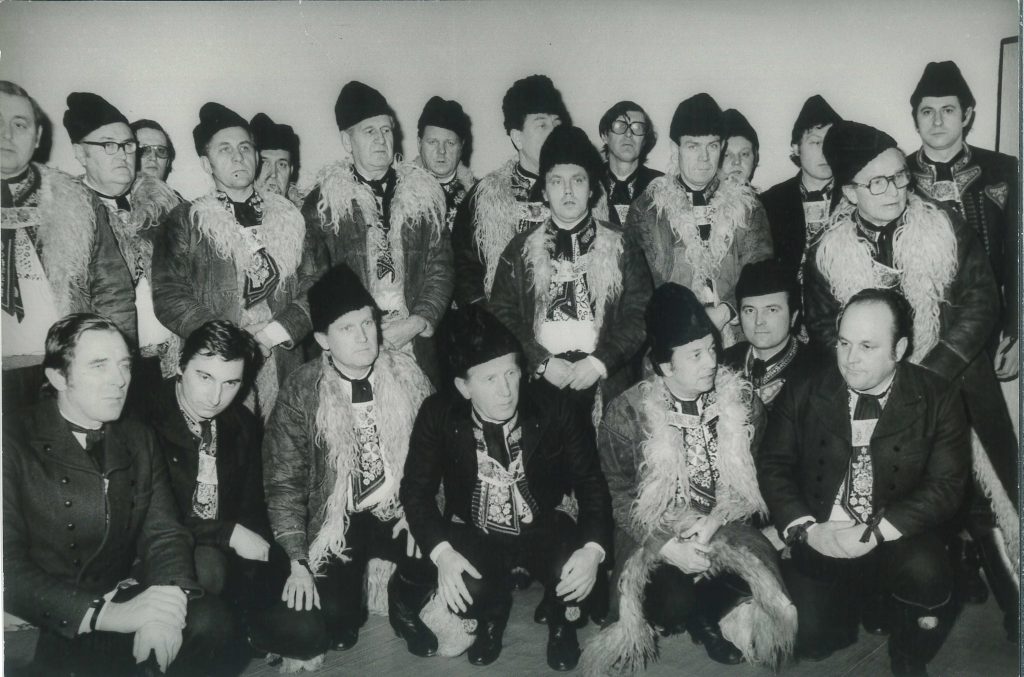
1980
Jan Pavlík

At the turn of the decade, the management changes and MUDr. Jan Pavlík's collaboration with CM Jury Petrů begins; choreographer Jan Loutchan is invited to the rehearsals and new program blocks are born.

The ensemble rehearses intensively, films for radio and television and performs at festivals (Slovácký rok, Strážnice, Milotice). It also travels abroad repeatedly.

In 1982–1983, jubilee events are added (40 years of the ensemble, anniversary of Jura Petrů and A. Kůr), radio recordings with BROLN and the ensemble appears on TV.
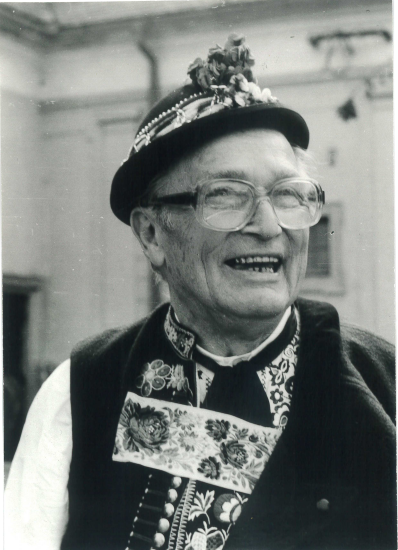
1985
Jura Petrů (1953) leads the male choir

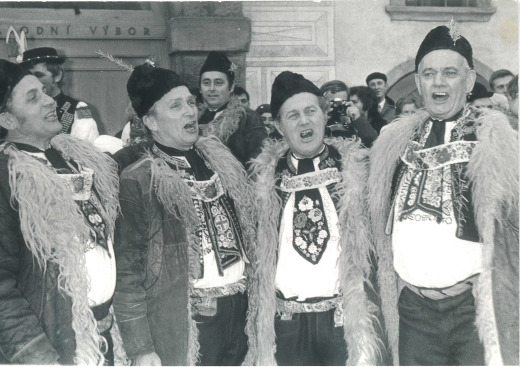
He takes over from his father and systematically expands the repertoire, searches for and returns "forgotten" songs and unifies the choir's expression in connection with the band of Jura Petrů.

In the beginning, he was supported by Božek Frýbort - the then leader of the ensemble (1982–1988) and in the years 1984–1988 also the leader of rehearsals - who stood up for "new" songs

This is immediately followed by publishing and recording work - in 1986 the songbook "K městečku Kyjovu" with recruit and military songs from the Kyjov region is published, which confirms his role as a collector and programme dramaturge. Jura leads the choir to this day and over the years has prepared many songbooks and an even larger number of musical recordings.

1986

Due to increasing organizational requirements, the position of organizational leader is introduced, which is first taken on by Zdeněk Langášek.

At this time, the ensemble also begins to cooperate with a group of women from Ježov, who enrich the body of knowledge of forgotten customs, ceremonies, dances and songs of the North Kyjov region.

New stage performances are created.

1986
Slovácký soubor Kyjov

Introduction of the final form of the name Kyjov Moravian Ensemble.

1988

Milan Pokorák is elected to the position of artistic leader and dance rehearsal leader.

During his era (1988-2013), the ensemble gains a firmer order and its choreographic level develops. At the same time, the interconnection of individual parts and mutual support are developed. 

In collaboration with Jiří Petrů, new programs of songs and dances are created, drawing exclusively from materials from the Kyjov region.

1991
Association of Friends of the Ensemble

The Association of Friends of the Ensemble is established as the moral and economic support of the ensemble, which subsequently becomes the founder of the ensemble into which all parts are incorporated (prep group, dance group - "ensemble", male and female choir, cimbalom band and later also Pajtáši – group of experienced dancers). MVDr. František Lukl was elected the first chairman.
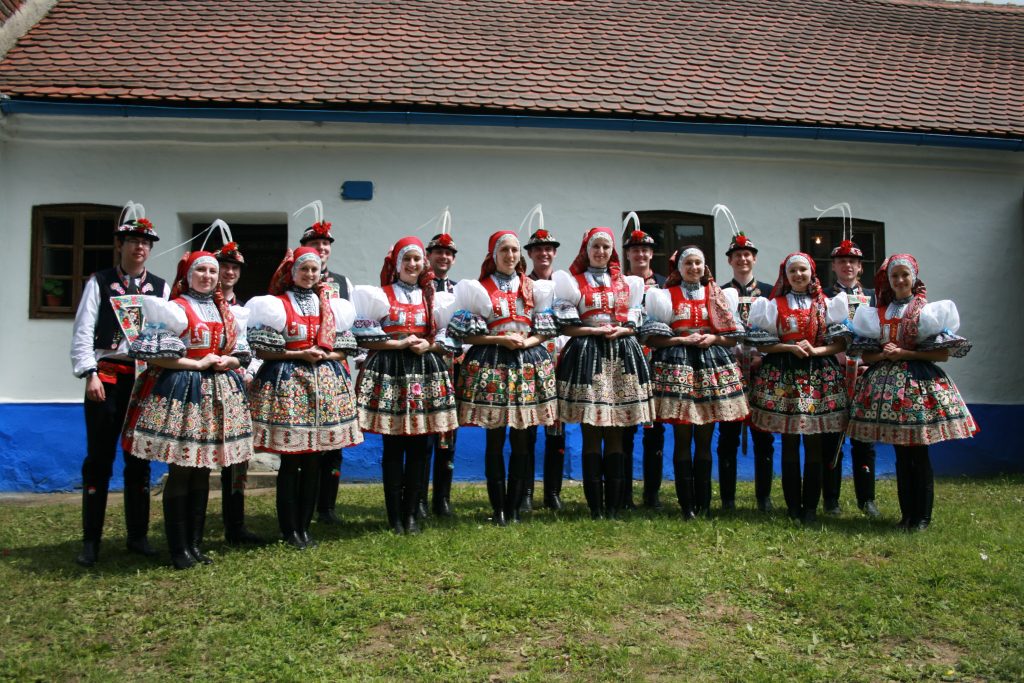
The 90s

In the 90s, the company's operations were continuous and stabilized - the individual parts (dance, male/female choir and band) operated in a clear regime and, in addition to the stage, the customs were systematically maintained and renewed;

With the change in circumstances, foreign trips expanded: England (1992), Switzerland/France (1993), USA & Canada (1994, CIOFF award), Spain (1995) and Japan (1998, CIOFF Japan award).

Parallel publishing and recording work was carried out – songbooks (Ej, létala laštověnka, 1990; Zpíváme vKyjově I–III, 1995/1996/1998), thematic publications and media (LP Slovácký rok v Kyjově, 1990; CD Legrúti jedú, 1994; collaboration on Zahučaly hory, 1999).

Beginning of the millennium

The ensemble continuously combines stage programs with maintaining the customs; recordings are increasing (e.g. collaboration on Radioservis and BROLN projects) and regular participation in domestic and foreign festivals. The male choir won the Foskar award in 2002 and 2006. Tomáš Machlínek was the first winner of the competition for the best Slovácký verbuňk dancer from the ensemble. Martin Jelínek (2x) and Jakub Džubera followed.
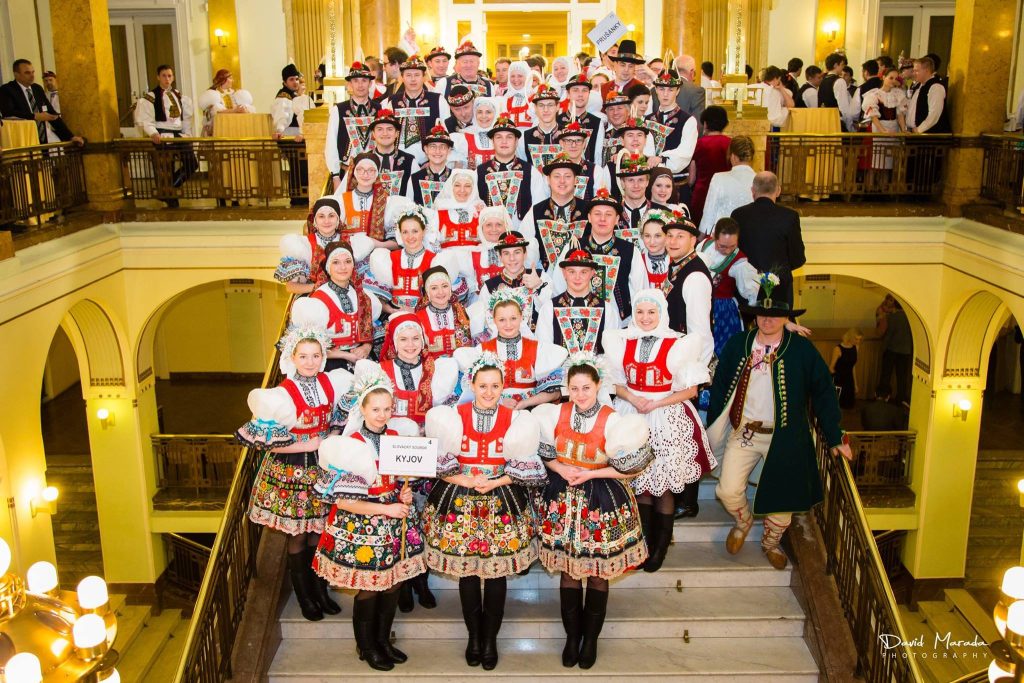
2014

Due to changes in legislation, the association is transformed into a club. At the same time, the dance group Pajtáši is established this year under the leadership of Dušan Janovský.

2010-2019

During this period, the male choir remains stable and at a high level, continues to record and regularly performs at domestic events and projects.

In contrast, the leadership of other groups changes more frequent; this is most noticeable in the dance group after the departure of Milan Pokorák in 2013, when several leaders changed in rapid succession.

These changes did not help the continuity of the preparations and repertoire as the ensemble would have liked; nevertheless, the ensemble continuously maintained its customs and filled the calendar of performances at home and abroad. The winner of the competition for the best dancer of the Slovácko verbuňk in 2017 was Pavel Fridrich.
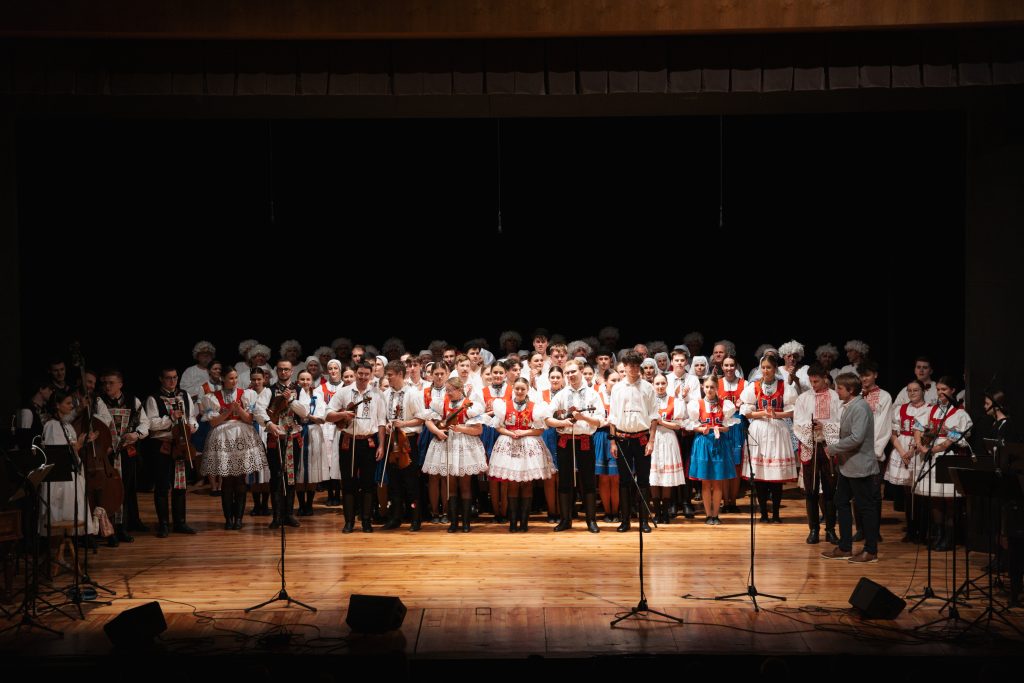
Present

In the last decade, the activities of the ensemble have been significantly affected by the Covid pandemic, which practically paralyzed the ensemble's activities - rehearsals and public events were reduced to a minimum. After being dissolved again, the dance part and the prep group were merged in 2021 due to interrupted continuity and accelerated generational change.

At the end of 2022, these parts were separated again, the organization stabilized, and the impetus in the form of the 80th anniversary helped, in the program of which previous generations of dancers also participated. It is worth mentioning Martin Vašulka, who won Strážnice in 2019 and 2022 (in 2022, he was no longer an active member). The last major event was the premiere show in December 2024, in which all members of the ensemble presented themselves on one stage.

Timeline

Names and founders of the ensemble
  • 1942 — 1969 Slovácký krúžek 
  • 1969 — 1975 Slovácký soubor 
  • 1976 – Slovácký soubor Josefa Klvani
  • 1976 — 1986 Slovácký soubor 
  • 1986 — today Slovácký soubor Kyjov 
  • 1942 — 1949 Josef Sedlář
  • 1949 — 1950 prof. Ladislav Fiala
  • 1950 — 1952 Engelbert Kreidl
  • 1952 — 1961 Josef Fridrich
  • 1961 — 1964 Jiří Wenzl
  • 1964 — 1973 Josef Sedlář
  • 1973 — 1978 Jaroslav Zavrtálek
  • 1978 — 1980 Miroslav Kudr
  • 1980 — 1982 Jan Pavlík
  • 1982 — 1988 Bohumil Frýbort
  • 1988 — 2013 Milan Pokorák
  • Since May 2013, the role of ensemble leader has been combined with the role of chairperson — first of the Association of Friends of the Slovácko Ensemble Kyjov, and now of the Slovácko Ensemble Kyjov, registered association.
  • 1949–1964 Josef Sedlář
  • 1973–1980 Josef Sedlář
  • 1986–2002
  • Zdeněk Langášek
  • 2003–2006 Pavel Růžička
  • 2007–2014 Jakub Džubera
  • 2014–2018 Martin Zrzavý
  • 2018–2024 Jakub Švorba
  • 2024-2025 Jiří Krist
  • 2025-dosud Aleš Vaculovič
  • 1991–1992 MVDr. František Lukl
  • 1992–2007 Zdeněk Langášek
  • 2008–2014 Alena Melounková
  • 2014–2020 Dušan Janovský
  • 2020–2024 Milan Macháček
  • 2024-today Jakub Švorba
  • Leaders of rehearsals:
    • 1942 — 1952 Kliment Navrátil
    • 1952 — 1953 Jan Selucký
    • 1953 — 1957 Jan Selucky & Marie Navrátilová
    • 1957 — 1964 Jan Selucký, Rudolf Hochman, Marie Navrátilová
    • 1964 — 1967 Jan Selucký, Ivo Šimeček
    • 1967 — 1969 Marie Řiháková
    • 1969 — 1972 Bohumil Frýbort
    • 1972 — 1978 Zdeněk Šimeček
    • 1978 — 1980 Miroslav Jestřabík
    • 1980 — 1982 Jan Loutchan
    • 1982 — 1984 Zdeněk Vavřina
    • 1984 — 1988 Bohumil Frýbort
    • 1988 — 2013 Milan Pokorák
    • 2013 — 2014 Pavel Růžička
    • 2014 — 2016 Monika Mrkvová
    • 2016–2018 Petr Michalčík
    • 2018–2019 Bára Šalšová, Lucie Polášková, Vojtěch Půček
    • 2020–2021 Bára Šalšová Lenka Letochová, Vojtěch Půček
    • 2021–2025 Václav Stix
    • 2025-today Adéla Růžičková
    Leaders of Prep group:
    • 1973 — 1978 Bedřich Gazda
    • 1982 — 1985 Zdeněk Šimeček
    • 1986 — 1988 Milan Pokorák
    • 1988 Renáta Janíčková
    • 1989 — 1991 Blanka Pokorná
    • 1991 — 1992 Sylva Hudečková
    • 1992 — 1999 Ludmila Pokoráková, Pavel Prokeš
    • 1999 — 2003 Ludmila Pokoráková, Ladislav Šimeček
    • 2003 — 2005 Ludmila Pokoráková, Jindřiška Matějáková, Martin Jelínek
    • 2005 — 2006 Ludmila Pokoráková, Pavlína Polášková
    • 2006 — 2008 Ludmila Pokoráková, Lenka Pokoráková
    • 2008 — 2010 Ludmila Pokoráková, Hana Novosadová, Jakub Polášek
    • 2010 — 2013 Ludmila Pokoráková, Hana Novosadová, Petra Lebedová
    • 2013 — 2014 Hana Novosadová, Petra Lebedová
    • 2014–2016 Zdena Kyněrová, Hana Novosadová, Petra Lebedová
    • 2016–2017 Zdena Kyněrová
    • 2017–2018 Hana Novosadová
    • 2018–2021 Václav Stix
      (In 2021, the preparatory group was merged with the dance section; in December 2022, the two were separated again)
    •  2021 – today Vít Hudec, Marie Folvarčná, Veronika Možíšová, Štěpán Novák
    Leaders of male choir:
    • 1961–1979 Jiří & Josef Wenzlovi
    • 1980–1984 Jiří Petrů (1922) 
    • 1985–today Jiří Petrů (1953)
    Leaders of female choir:
    • 1972–1974 Josef Wenzl
    • 1978–1985 Jiří Petrů (1953)
    • 1985–1988 Eva Soldánová
    • 1989 Irena Trutmanová
    • 1990 Jiří Frolec
    • 1991–1992 Irena Trutmanová
    • 1992–2007 Eva Soldánová
    • 2007–2008 Irena Trutmanová
    • 2008–2009 Eva Soldánová
    • 2010–2013 Irena Trutmanová
    • 2014–2015 Lenka Vymazalová
    • 2016–today Eva Soldánová
  • Josef Sedlář (1919 — 2003)
  • MVDr. František Lukl (1918 — 2005)
  • Miroslav Kudr (1922 — 1995)
  • Josef Fridrich (1917 — 2010)
  • Jiří Petrů st. (1922 — 1984)
  • Ing. Kliment Navrátil (1925 — 2006)
  • Marie Navrátilová (1926), Josef Wenzl (1940 — 1986)
  • Ing. Bohumil Frýbort (1945)
  • Jiří Petrů ml. (1953)
  • Zdeněk Langášek (1948)
  • Milan Pokorák (1963)
 

The selection of “significant figures” is a very sensitive matter, as many people have worked — and continue to work — with great dedication for folklore in Kyjov. The selection presented here reflects the views of the respective generations.